
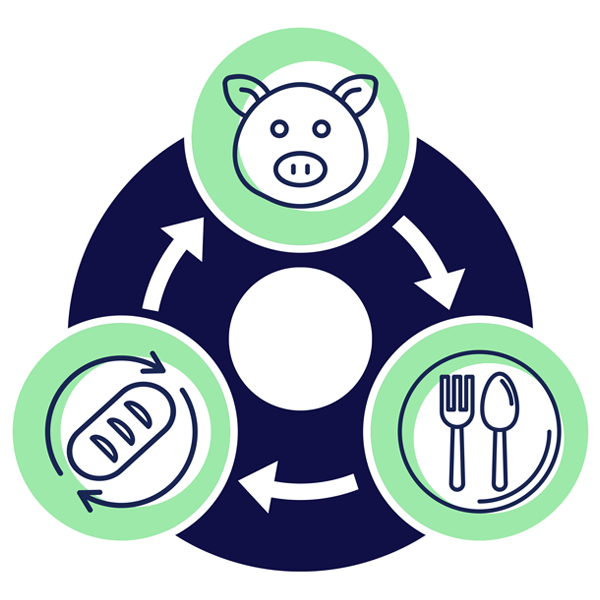
The cluster Circular Animal Protein Chain
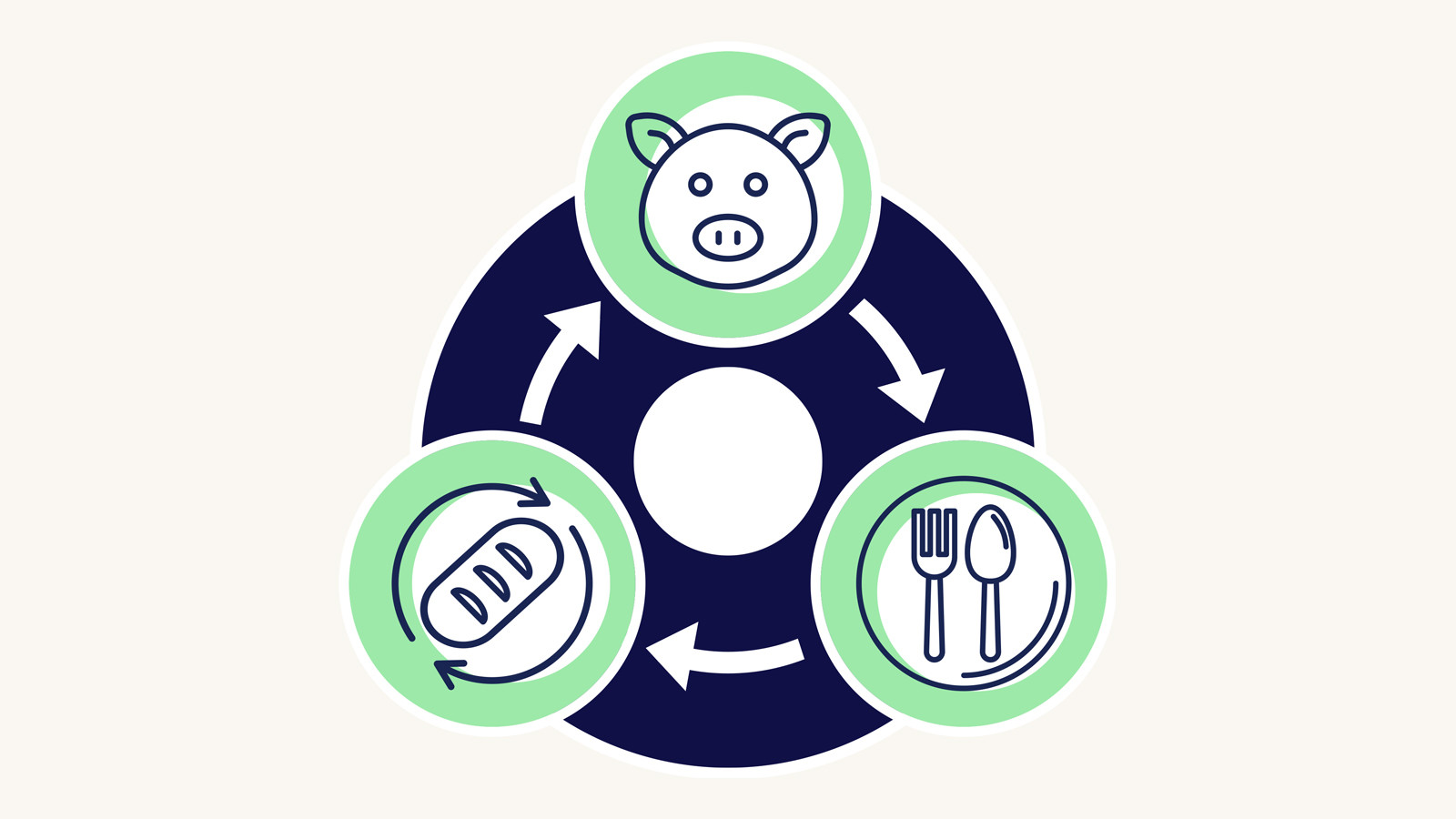
The cluster Circular Animal Protein Chain was established on the initiative of Food Waste Free United (Samen Tegen Voedselverspilling). In this cluster, companies from across the entire chain collaborate on business models and innovative solutions to process residual streams from the food chain into animal feed on a large scale. The goal is a circular animal protein chain in which valuable raw materials with nutritional value remain within the food chain. This has many positive effects, such as lower greenhouse gas emissions to produce our food and reduced dependence on the international raw materials market.
Does your company work with animal feed or residual streams, and do you want to handle this more sustainably? Then join the cluster! Read the information below and email office@samentegenvoedselverspilling.nl.
Video about the Circular Animal Protein Chain
Why this cluster?
Residual streams are generated at every link in the food system chain. For example, vegetable trimmings in the food industry or unsold bread in supermarkets. Many of these residual streams are incinerated, composted, or converted into biogas through anaerobic digestion. However, valuable residual streams with nutritional value can often still be processed perfectly into animal feed (provided it is feed-safe). According to the Ladder van Moerman, this is a more valuable destination than incineration or biogas. This ensures that raw materials remain within the food chain and it reduces the CO2 footprint of animal feed and animal products. However, partly due to strict laws and regulations, challenges remain in this area.
How does the cluster work?
Within the cluster, companies from across the entire chain collaborate on business models to offer distinctive, circular products through supermarkets, specialty stores, or out-of-home. They aim to scale up innovations to close circular chains and are working on an attractive circular revenue model for all supply chain partners. This is achieved through mutual collaborations with partners who meet via the cluster. The cluster focuses on innovation, chain collaboration, and the changing of laws and regulations to keep more raw materials circularly within the food chain.
This is done at the initiative of Food Waste Free United, which manages the cluster, informs and motivates the participants, and organizes knowledge and networking meetings for the affiliated parties several times a year. In addition, Wageningen University & Research (WUR) provides support with knowledge and research. The cluster is financially supported by the Ministry of Agriculture, Fisheries, Food Security, and Nature.
Joining the cluster offers the following benefits:
Motivated network partners who want to work together on solutions.
Access to specific knowledge and figures via WUR.
Collaborative work on benchmarks through knowledge exchange.
Joint lobbying for the amendment of legislation and regulations.
Multiple annual knowledge, networking and inspiration meetings.
Participation in the cluster is free of charge, but requires active commitment from all parties to work on solutions and knowledge sharing. The participating parties are also required to become stakeholders of Food Waste Free United (Samen Tegen Voedselverspilling).
Who are the participants?


Participants of the cluster are: Darling Ingredients, FeedValid, Grassa, JEGG, Kipster, Looop, Nijsen company, Oranjehoen, Schothorst Feed Research, TopFeed, Vitalvé, Zonvarken, de gemeente Meierijstad, het Ministerie van Landbouw, Visserij, Voedselzekerheid en Natuur, de Provincie Noord-Brabant and Wageningen University & Research.
Successes: completed and ongoing cases
From circular pork chops to waste-free eggs; within the cluster, the participating parties are working on many different cases. A number are already complete, while others are ongoing or still in development.
Join the cluster!
Does your company also have residual streams (on a regular basis and on a large scale) that could be suitable for animal feed? Or do you work with livestock and do you want to reduce the CO2 impact of your livestock, animal feed and/or final product? Or is your company working on the circular animal protein chain in another way? Then join the cluster! Please contact us via office@samentegenvoedselverspilling.nl.